
Trav S.D. on Pintele
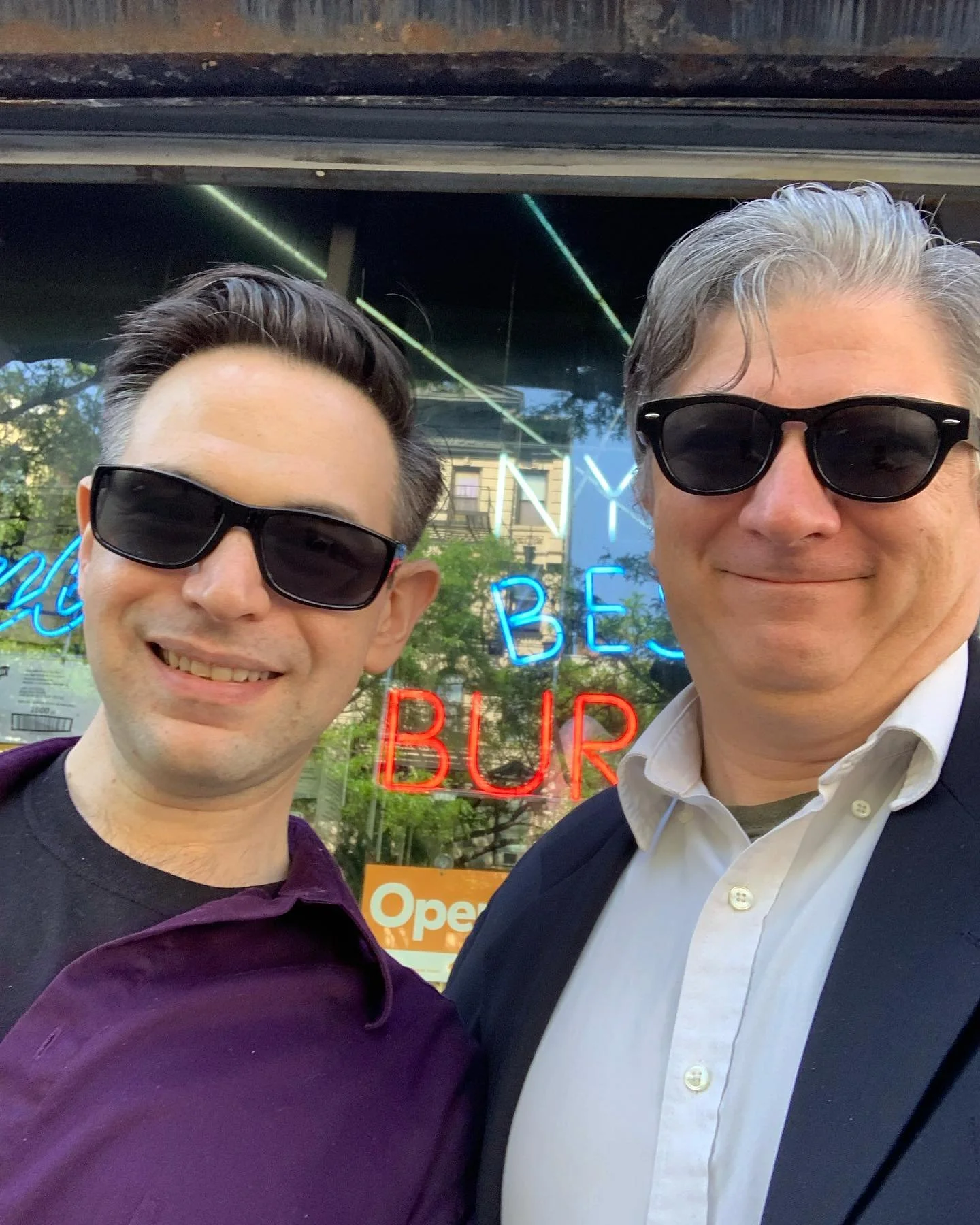
Before sharing Trav S.D.’s recently-published thoughts about Pintele, I should disclose that Trav and I are good friends, each on the record repeatedly as an admirer of the other’s work; and even more than that, our artistic paths have crossed often. Most significantly, it was through my collaboration with Trav that I’ll Say She Is made it to the stage (he produced and directed the Marxfest and FringeNYC premieres of the revival, and played a crucial role in helping me shape the libretto). It would be hard to follow my work or Trav’s over the last decade-plus without encountering the other, and I certainly hope we’ll work together more in the future. In Pintele 7 I name Trav and his extraordinary monologue The Pilgrim’s Progress as a key influence. So, all of this is to acknowledge that Trav’s thoughts about my work, like mine about his, are reliably sincere and candid, but are not exactly coming from nowhere.
On his venerable arts-and-culture blog Travalanche, Trav has written about Pintele a generous three times, first prior to the release of Part 1. On March 5, having heard the first four chapters, Trav published an essay entitled “Pintele at Mid-Pint,” which includes some of the most insightful (and also, let’s admit, flattering) things yet written about this work. For example:
By design, and entirely without surprise, Pintele is a work by, for, and from, a complete human being, not one who is artificially narrowing what he has to offer in order to please a portion (or even a majority) of his audience. This is a monumental act of honesty, and a brave risk. This is not to say that Pintele is not constantly funny and entertaining. It is. In fact, the reason I decided to do this mid-point report is because today’s episode, Episode Four, while every bit as thoughtful, is particularly rich in discussions of popular culture, including Fiddler on the Roof, Abie’s Irish Rose, The Jazz Singer, and particular artists like Jacob Adler, Boris Tomashevsky,Al Jolson, Eddie Cantor, George Jessel, and the Marx Brothers. But you cannot, you must not skip ahead or you will be missing the entire point of the show. It’s an autobiographical exploration of the Jewish identity that CONNECTS Noah to these cultural products. It gets deep into his family history all the way back to the Old Country, through pogroms and genocide, and into his own childhood.
Episode Two may be the most challenging. Noah pulls no punches on the topic of religion, and he is as unsparing of Christianity as he is of Judaism. Now that Madalyn Murray O’Hair is dead he may be the boldest and most outspoken atheist I’ve heard comment on the subject, including my wife, who thoughtfully mutes her true sentiments in order to spare my feelings. (My own beliefs are roughly parallel to those of the Unitarian Universalists, a little 18th century Deism here, a little 19th century Transcendentalism there. I’ve read too much philosophy to be able to sign off with certitude on ANYTHING, including the non-existence of God — whomever She may be). Noah’s got no such compunctions, and you may end up smarting and tending some wounds after some of his digs. I should add that, speaking personally, I think Noah is at his absolute funniest when he’s meanest. Because that’s when he’s at his most honest, and it is no doubt coming from the same place as the funny honesty he associates with the ancestors he genuinely reveres. Oh, yes, you people who to try to make life simple. You can revere and honor and love your ancestors without signing off on their prejudices and superstitions. I try to do the same thing all the time. I have to in order to remain sane.
And then, when the Pintele series wrapped up with the release of Part 7, Trav published a perceptive afterword, “Parting Words on Pintele,” on March 27.
If for some reason you’re not already an avid regular reader of Travalanche, start immediately! And please consider supporting Trav’s work with a Patreon subscription at whatever monthly rate you choose.
