
Pintele Part 7: Next Year in Manhattan
The series concludes with a look backward and forward. Still seeking answers, we consult Jewish sages like Maimonides and Aunt Sarah. We scratch out a pleasant, simple tune. We recall the genesis of this series, and we begin to understand who we are as Pintele Jews.
Listen now: Spotify | Apple Podcasts | Amazon Music Podcasts | YouTube | YouTube Music Podcasts | Pandora | iHeart Radio | Podbean | rss.com | Listen Notes | Podchaser | and more

Maimonides
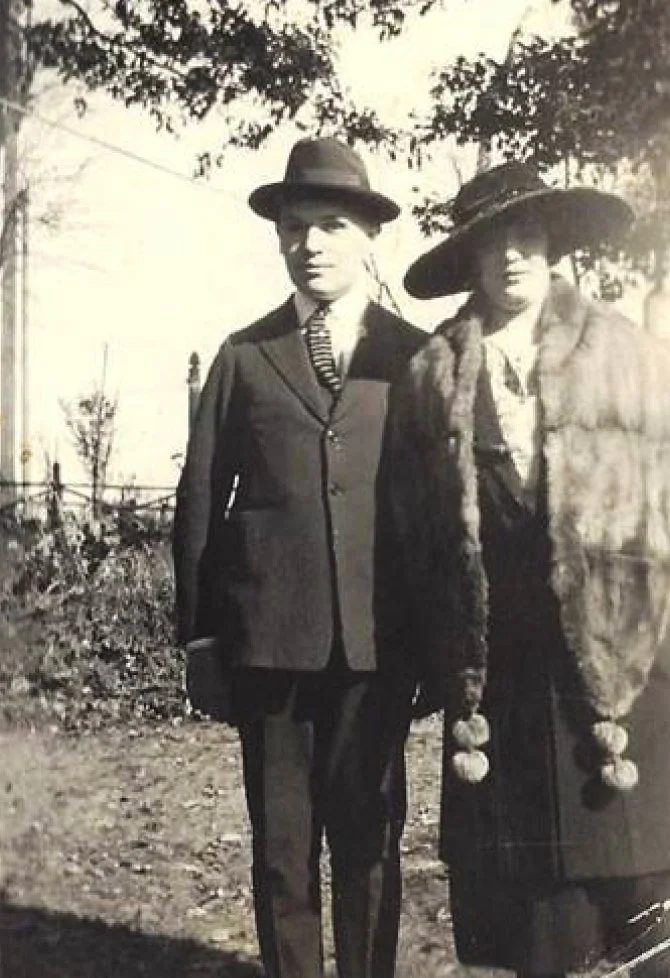
Dan and Tillie Pomeranz, my paternal great grandparents, sometime in the 1930s
For a general explanation of the differences among Reform, Conservative, and Orthodox Judaism, see this article from My Jewish Learning. The article is good enough to include a few “smaller denominations,” including Humanistic Judaism, the god-free movement founded by the great anti-theistic rabbi Sherwin Wine. Humanistic Judaism has much to offer Pintele Jews who crave the community and ritual of religious practice without all the god stuff. Here in New York, the City Congregation for Humanistic Judaism maintains a robust schedule of services, classes, and other activities.
For help sorting through Maimonides, I’m indebted to the mensches at jewfaq.org. Their guide to the 613 mitzvot is well-considered. Maimonides is worthy of study; his twelfth-century Guide for the Perplexed, an early attempt to reconcile Jewish theology with Aristotelian reason, might be my next stop.
Speaking of the Messiah: never mind theology; I’ve got a Fiddler anecdote! The funniest piece of material written for Fiddler on the Roof was a song called “When Messiah Comes,” which was cut from the show during tryouts in Detroit. The song took place toward the end of Act Two, when the Tsar’s “get thee out” edict has been issued and everyone is sadly preparing to leave Anatevka. As in the finished version, one of the villagers says, “We’ve been waiting for the Messiah all our lives. Wouldn’t this be a good time for him to come?” And then, Zero Mostel as Tevye would step forward and deliver this song, which began, “When Messiah comes, he will say to us / ‘I apologize that I took so long.’” Bock and Harnick were proud of the song, and Zero loved singing it, but the audience response indicated that this moment in the story was inappropriate for a comic number, even a dark one. It’s a classic example of first-rate material rightfully excised. The best available recording of “When Messiah Comes” is performed by the lyricist himself on the 1977 LP An Evening With Sheldon Harnick. Listen to the laughs he’s getting!
The story about my paternal great grandmother, Tillie Weiner, is from a family history assembled by my cousin Jonathan Naiman, and shared with me by my uncle Rick Diamond.

Sarah Ragovin Brody in the 1930s, 1940s, 1960s, and 1990s
Here is the appalling “creationism song” from the usually wonderful Mister Rogers’ Neighborhood. Until locating the video on YouTube just now, I had not heard it since childhood, and it turns out I slightly misremembered it; the opening line credits “god” with creating rainbows, not flowers. Flowers are mentioned later, along with the sky, birds, rain, snow, people, the sun, mountains, stars, sea, and land. I remain shocked that this was broadcast to children on public television, by a trusted educator. That’s how Mister Rogers earned the asterisk I attach to my otherwise positive feelings about him.
For more on the story behind “Hava Nagila,” see “Hava Nagila’s Long, Strange Trip” by Dr. James Loeffler; “The Secret History of ‘Hava Nagila’” by Dr. Loeffler and Edwin Seroussi, Tablet, 2019; and this 2021 discussion of the documentary Hava Nagila: The Movie. As suggested in the episode, my love for this song has crept up on me and surprised me. It’s now forever in my head, where it is welcome.
Repeated expressions of gratitude to the Jewish Historical Society of Greater Hartford and their extraordinary oral history collection, where you can listen to Sarah’s interview and hundreds of others.
The cover of my 1990 middle school report, featuring interviews later used in Pintele
For a brilliant and terrifying analysis of the possibility that the golden age of American Jews is ending, see “The Golden Age of American Jews is Ending,” Franklin Foer, The Atlantic, April, 2024.
If you’re interested in Rika Zaraï, you’ll enjoy this 1969 French television appearance.
If you’re interested in Tom Lehrer, do what I do and spend your entire life constantly listening to his records!
The two theatre pieces mentioned as influences on Pintele, both originally performed by their authors, are What the Constitution Means to Me by Heidi Schreck and The Pilgrim’s Progress by Trav S.D. As long as we’re on the subject, if you’ll permit me the indulgence of acknowledging some other important influences on this work, there’s Avi Hoffman’s Too Jewish? (mentioned in Part 5), John Leguizamo’s Freak, and Young Jean Lee’s Songs of the Dragons Flying to Heaven. During the time I was writing Pintele, my friends Tom and Nancy Hamel took me to see Tom Stoppard’s Leopoldstadt on Broadway; this profound experience especially informed the first chapter. The Letters Project by Eleanor Reissa is another important source of inspiration and example; I especially recommend the audio version, read by the author, which helped me find the narrative voice for Pintele. (Eleanor Reissa is the acclaimed concert artist and storyteller whose recording of “Lebn Zol Columbus / Yankee Doodle Boy,” from the record Going Home: Gems of Yiddish Song, was heard in Pintele 1.)
Fans of the Mamales (including new fans who’ve just heard their “Abi Gezunt” at the end of Pintele 7), will enjoy the trio’s delightful “Abi Gezunt” concept video. Maya Jacobson, Raquel Nobile, and Jodi Snyder met in 2018 as cast members of the Off Broadway Yiddish version of Fiddler on the Roof, and went on to form this outstanding Yiddish harmony trio. Hopefully we’ll be hearing more from the Mamales, live and recorded, in the near future. In the meantime, you can follow them on Instagram and YouTube, and read coverage of their efforts from the Jerusalem Post and Save the Music. Their Instagram bio includes contact information for booking inquiries. They call themselves the Mamales in tribute to the 1938 Molly Picon film Mamele, which introduced “Abi Gezunt.” You can watch Picon’s performance of the song here. You can find the lyrics here, in both Yiddish and English.
The song’s title phrase, as explained way back in Pintele 1, means So long as you’re healthy. The complete refrain, Abi gezunt ken men gliklekh zayn, means So long as you’re healthy, you can be happy. My sincere thanks to Maya, Raquel, and Jodi for generously allowing me to include their work in Pintele!
