
Pintele Part 2: God and Other Gods
In the second chapter, we ask big questions: Is there a god? How can we discuss Jewish identity if nobody knows what it is? And what if Jesus had been a Borscht Belt comedian? Also, Red confronts Sarah about religion, and I recall being the only Jewish kid in school.
Listen now: Spotify | Apple Podcasts | Amazon Music Podcasts | YouTube | YouTube Music Podcasts | Pandora | iHeart Radio | Podbean | rss.com | Listen Notes | Podchaser | and more
.JPG)
jewfaq.org: “The mezuzah is not, as some suppose, a good-luck charm… Rather, it is a constant reminder of [god’s] presence.”
If you’re here because you’ve just listened to Pintele 2, welcome! If you’re here for some other reason, welcome to you too, but you really should listen before proceeding with these endnotes.
So, thanks for listening — and extra thanks to those who made it through Pintele 2 despite disagreement with its critique of religion, or discomfort with my irreverence on the subject. I hope you at least found this chapter to be in, um, good faith. Thank you for hearing me out.
My arguments about the nonexistence of god are the result of thinking about it for decades. Although nobody has perfectly expressed my exact personal thoughts on this matter, some thinkers who’ve influenced me are Mark Twain, Bertrand Russell, Thomas Paine, Woody Allen, Christopher Hitchens, and Chrissy Stroop. But long before I understood that nonbelief was an intellectual tradition, it was my natural response to the experience of living in a godless universe.
A lot of the anti-atheist rhetoric of recent decades has focused on the so-called “new atheists,” whose arguments rose to prominence after the faith-based attacks of 9/11. This vaguely-defined group sometimes included Hitchens, Richard Dawkins, Ayaan Hirsi Ali, Daniel Dennett, and Sam Harris, as well as entertainers like Sarah Silverman, Julia Sweeney, Bill Maher, Ricky Gervais, and Stephen Fry. The primary criticism is that atheistic thinkers have been snide or insulting when speaking about religious people. It’s a fair criticism of some of these figures, sometimes. But the idea that nonbelievers in general are exceptionally angry or unpleasant is simple bigotry. I strongly favor civility and believe we can describe the indifference of the universe without calling anyone stupid. I can only hope I’ve expressed myself candidly and amusingly, without insulting anyone.
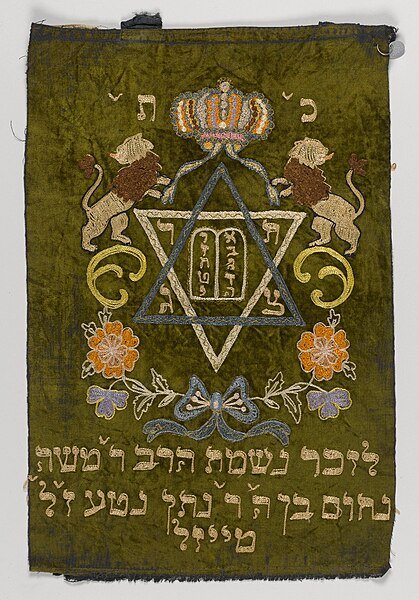
Torah cover, Brooklyn Museum
The profound exchange between Grandma Red and Aunt Sarah is repeated exactly as Red recounted it to me in the early 1990s. We were in Florida, in the car. This was the same conversation in which she said (as quoted in Pintele 1), “I believe in nuttin’, love, nuttin’ at all – except for your beauty-full face.” (She said things like this on many other occasions, too, but this is an example I remember vividly.)
Regarding comedy legend and national treasure Whoopi Goldberg’s 2022 comments about the Holocaust, I refer you to Joy Reid’s coverage (and interview with Yair Rosenberg) as well as the New York Times’ coverage of Goldberg’s temporary suspension from The View. There’s more about her apology from CNN; see also Whoopi’s February 2022 appearance on Colbert.
More details can be found in the Times’ coverage of the banning of Maus from McMinn County, Tennessee public schools. Art Spiegelman gave many interviews in 2022 in connection with this incident; one of the more generous was for Democracy Now! It was Grandma Red who first introduced me to Maus, having clipped articles for me from the Times and the New Yorker. Partly because of my age and awakening Jewish identity at the time Maus was first published (the first volume in 1986, the second in 1991), Spiegelman immediately became one of my big heroes. Like many of my heroes, he’s as interesting an interview subject as an artist; I especially enjoy this conversation between Spiegelman and Tony Kushner (another of my major Jewish art heroes) at the Jewish Museum in 2015. An excellent PBS American Masters documentary, Art Spiegelman: Disaster is My Muse, was released in 2025.
Yair Rosenberg is quoted from “Are Jews a Race?,” The Atlantic, February 1, 2022. Daniel Boyarin is quoted from A Radical Jew: Paul and the Politics of Identity. David Baddiel is quoted from his wise and prescient cri de cœur Jews Don’t Count; it’s a point he’s also made in countless media appearances since 2022. Some of Baddiel’s observations are specific to the British Jewish experience, but his core point is relevant everywhere, and anyone interested in these questions — perhaps especially non-Jewish progressives — should be familiar with his thinking. Start with Jews Don’t Count; it’s a compact “essay book” which you’ll read in one sitting. In 2022 Baddiel produced an hourlong Jews Don’t Count documentary for the BBC.
I know there are various arguments to the effect that “the chosen people thing” isn’t as obnoxious as it sounds. But even if these arguments are valid, the admission that it does sound obnoxious should be enough to outweigh them.
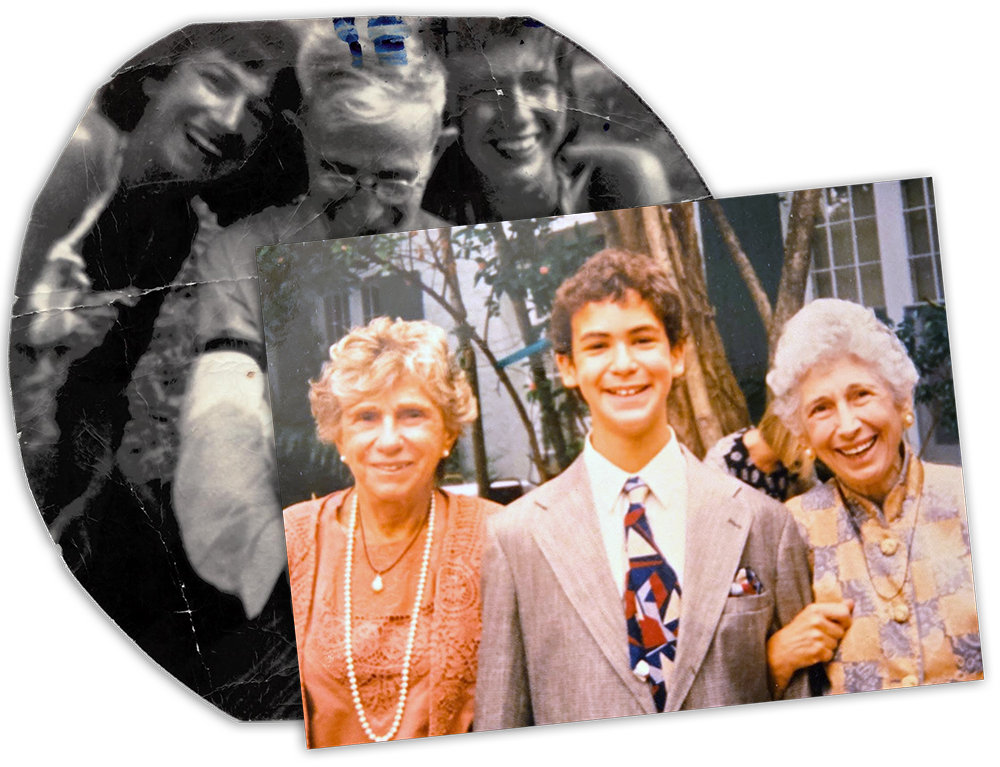
In black and white: Sarah (left) and Red with their father, Simon Ragovin, circa 1954. In color: Red (left) and Sarah with Red’s grandson, Sarah’s great nephew, my brother, Joe, at his bar mitzvah in 1995.
It’s often noted that many of the most popular American Christmas songs were written by Jews. (If you like listicles, Kveller has a nice one.) I’m just having fun when I say that secular holiday music is “thanks to the heroic efforts of mighty Jewish songwriters.” Really, this is true of many kinds of songs, simply because a disproportionate number of America’s popular songwriters during the first half of the twentieth century were Jewish. My line about the “dimly-lit, claustrophobic song shops of West 28th Street” is a reference to Tin Pan Alley, in the manner of common descriptions of sweatshops, particularly in downtown Manhattan and in the garment district. I visited Tin Pan Alley in If You Get Near a Song, Play It: The Marx Brothers and Music.
“The Sermon in the Mountains,” believe it or not, is derived largely from the “Sermon on the Mount” as presented in the Gospel of Matthew, which I’m sure you’ll agree was in need of a few solid laughs. Any aspiring messianic figures out there who are looking for a joke-writer, please get in touch.
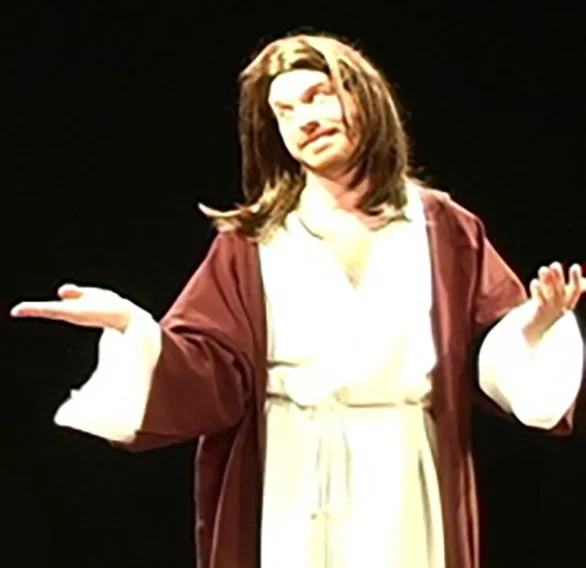
“The Sermon in the Mountains” is not my first time writing for Jesus. Here’s the divine Corey Moosa in the role, from Burning Bush: A Faith-Based Musical (2005),written by Amanda Sisk and me.
As stated in Pintele 2, I don’t make a big sport out of debunking the Bible. I’ve read it; that was enough. For Biblical references, I rely on the exemplary work of Steve Wells, whose Skeptic’s Annotated Bible is one of the crowning achievements in the history of the internet. (The print edition is great too.) Jesus says the Jews will be “cast out into outer darkness” with “weeping and gnashing of teeth” in Matthew 8:12. In Matthew 10:14-15, he says that unless you “receive” his teachings, his dad will destroy your city. Again in Matthew 11:21-24, he “condemns entire cities to suffering and death,” as stated in Pintele 2. He says the same thing in Mark 6:11 and Luke 10:13-15. In Matthew 10:34-36, he admits that he “came not to send peace, but a sword,” then openly fantasizes about families fighting each other (“And a man’s foes shall be they of his own household”). He can’t even deal with the idea that you might love your own parent or child more than him. (“He that loveth father or mother more than me is not worthy of me, and he that loveth son or daughter more than me is not worthy of me.”) In John 3:36, “he that believeth…hath everlasting life,” while all others “shall not see life; but the wrath of god.” (See also John 3:18.) In Matthew 25:41-46, those who don’t follow him are “cursed into everlasting fire [and] punishment.” In Mark 16:16, if you don’t “believe” and are not “baptized,” you “shall be damned.” In John 8:23-24, “if ye believe not” that Jesus is “from above,” then “ye shall die in your sins.” In John 14:6, he again declares that following him is the only righteous path. In John 15:6, anyone who “abide[s] not in me” is “cast into the fire” and “burned.” “The Jews” are blamed for plotting to kill Jesus in John 5:16-18, 7:1, 10:31, and 11:8; and for the actual killing of Jesus in John 19:7, 19:12, and 19:14-15. Jews are “of [their] father the devil” in John 8:44. Fans of casual antisemitism can find more in John 7:13, 19:38, and 20:19.
Dara Horn, in her revelatory work People Love Dead Jews, memorably refers to Anne Frank as “everyone’s second-favorite dead Jew.”
Regarding the popular, misguided notion that Christians who do evil things aren’t really Christians, nobody is more insightful than Chrissy Stroop, ex-evangelical leader and founder of the Empty the Pews movement. Read Stroop’s essay “Stop Calling Them Fake Christians,” then proceed to the rest of this important thinker’s powerful and essential work.
Demographic information about American Jews, including what’s cited in this chapter of Pintele, is available from the Pew Research Center (see “A Portrait of Jewish Americans,” 2013 and “Jewish Americans in 2020,” 2021, distilled as “Ten Key Findings About Jewish Americans”). More information is available from the Jewish Virtual Library. We’ll get into these findings in more detail in Pintele 6: Tyrants Disappearing.
Friend and Pintele listener Janet Heit notes that this 2010 study helps establish that (to quote from the study’s long title) “Major Jewish Diaspora Populations Comprise Distinct Genetic Clusters with Shared Middle Eastern Ancestry” — or, as Janet summarizes, “We really can be in it just for the jokes!”
Coming up next: Aunt Sarah and Uncle Joe will return in Pintele 3: A Very Brody Passover.
